Tuesday, November 16, 2010

Action Replayy lacks Art and Soul

By Anant Mathur (November 16, 2010)

SPOILER ALERT:
If you haven't seen Action Replayy please do not read on, certain parts of the story may be revealed in this post.
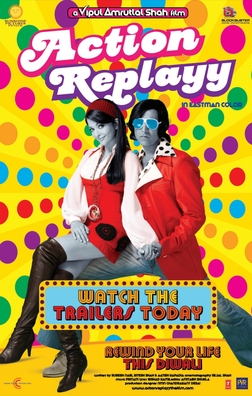
 

After watching Action Replayy one thing is certain - the director is a moron. Vipul Amrutlal Shah, if you don't know anything about science don't make a film about time travel. Travelling back in time should not be about a fashion statement. It's fine that you're trying hard to cover up the fact that you've ripped off the story from Back to the Future (and don’t want to get sued) but do a good job of it. This film is so bad I don't even know where to begin.

When I watch Back to the Future I know exactly where the money from the $19 million budget was spent. Watching Action Replayy it's hard to imagine it cost 65 crores (according to Komal Nahta) to make it. Action Replayy should cost no more than 4-5 crores to make (not including salaries of Akshay Kumar and Aishwarya Rai); there are no lavish sets, no mind-blowing special effects and certainly no story or extraordinary song sequences. So, where did the money go? Did Vipul Amrutlal Shah keep the money or did he pay Aishwariya Rai and Akshay Kumar 15 crores each as salary?

Back to the Future is a classic and one of my favourite films. In fact, I'm one of the biggest fans of
Back to the Future and the time travel genre in particular. I can still remember the first time I saw Back to the Future, I was 11 years old and I saw it at my cousin’s house. It became an instant favorite of mine, I have seen it countless number of time since then. The great thing about Back to the Future is the details that went into scripting it. And that's the most important element missing from this farce called Action Replayy.

In
Back to the Future, the mall - where Marty first sees the time machine in 1985 - is called Twin Pines Mall. When he travels to 1955 he ends up on a farm that stood in place of the Mall (since the mall culture hadn’t started yet). Old Man Peabody owned the farm and had two pine trees, hence the name Twin Pines Mall. When Marty leave the farm in his DeLorean he runs over one of the pine trees and destroys it. Finally, when gets back to the future the mall is now called Lone Pine Mall the name changed because on of the pine trees was destroyed. Remember, Statler Toyota, it was a Toyota dealership in Back to the Future in 1985 – they were promoting the 4x4 Marty wanted. When Marty reaches 1955 the dealership is called Statler Studebaker, since Toyota didn’t exist back then. Its details like this which makes Back to the Future special. There are thousands of little details like this in Back to the Future but none in Action Replayy.
 

Bunty (Aditya Roy Kapoor) uses the time machine built by his girlfriend’s Grandfather (Randhir Kapoor) to arrive in 1975. The time machine crash lands and is destroyed; yet at the end of the film it looks brand new as Bunty goes back to 2010. That's all you see or hear about the time machine. There's no explanation of how it got fixed or who fixed it. At the end of the film, when Bunty is going back, Randhir Kapoor appears with the time machine and waves goodbye to Bunty as he leaves – WTF! Why is Randhir Kapoor of 1975 helping Bunty? How does he know Bunty is telling the truth about Tanya, his granddaughter isn't even born yet? How does Bunty convince him to fix the time machine? And if Randhir Kapoor had the technology to fix the time machine in 1975, why didn’t he build it back then? None of this is explained.

When Bunty arrives in 1975, at first he isn’t sure if he made it. I’m still not sure if he made it because all the scenery looks exactly the same in 1975 as it does today which is impossible. I mean show me that where buildings stand in 2010, it’s a slum area in 1975 or something, so I know he’s in a different era. I mean, Vipul Amrutlal Shah, didn’t even show any old cars, occasionally you see a old Ambassador or a fiat or a Cadillac, but not in bunches. In any time travel film when the protagonist arrives in the past or the future, the first thing the audience notices is the difference in scenery, technology and the cars/transportation – there’s none of that in Action Replayy.
 

I moved from India when I was a kid and went back for the first time after 12 years. In 12 years, everything had changed drastically – it literally felt like I travelled 12 years into the future. There were parks where it used to be empty grounds; homes which were 1 story high now had 3 stories. Several shops had gotten bigger while others were no longer there. Even the small temple which used to be in my neighborhood was now exponentially larger. There were multiple new models of cars, technology was at par with the west and architecturally - the new buildings were beautiful. If all this can happened in a 12 year period from the late 1980s to the late 1990s - you can image how much would change from 1975 to 2010 especially in a big city like Mumbai. 

The buildings, in Action Replayy, should’ve looked different, roads weren’t that wide in the 1970s and shops were different. Showing an old movie theatre doesn’t tell me that Bunty is in the 1970s – it could just be an old theatre. Show what has changed - where is the open land where buildings now stand in 2010? There’s no reference to things like this.

There’s a scene in Action Replayy, in 1975, where we are shown a sign for a café called Bollywood Café. The term Bollywood was coined by Bevinda Collaco sometime in the late 1970s. It wasn’t in common use until the 1990s, so it is highly doubtful that there would be a café called Bollywood Café in 1975 Mumbai. How Bollywood filmmakers call themselves filmmakers is beyond me, not an ounce of research goes into their films. As bad as some Hollywood films maybe, there’s no doubt the research that goes into them. In Hollywood, even a film with a budget of 2 million is well researched, yet a 65 crore Bollywood film can’t even get simple facts right!
 

One more thing that doesn’t make sense is, in the future, Bunty looks to be in his mid 20s, which means he was probably born in the mid-1980s because his parents, who didn’t get along, didn’t have him for a few years after marriage, which is fine. But once he changes the past one would think that his parents, who are now in love, wouldn’t wait 10 years to have a kid, so he should be a lot older. In Back To The Future, this is not an issue, because Marty was the third born and the parents didn’t hate each other when they got married originally. But when you’re an only child, like Bunty, things could change drastically when you mess with time travel. Also, if his parents are in love with each other now, wouldn’t they have had more kids in the new future? And if Bunty is born a few years earlier who’s to say that he wouldn’t be a girl in the future? Has Vipul Shah heard of the Butterfly Effect? I doubt it.

Action Replayy would've been a better film if director Vipul Amrutlal Shah presented it as a stand-up comedy act with the lead actors hitting all the punch lines at the right time as in Comedy Circus. A film about time travel needs a solid story even if time travel is a means to an end and not the important part of the story.
 

In Back To The Future, all the music was songs of the 1950s - the era Marty gets sent to - and it gave the film authenticity. In our desi version all the music is from today, there’s no mention of any songs from the 1970s not even in the background. And why are they singing and dancing to hip hop/rap in the 1970s as if everyone knows it?

It is also never explained where Bunty is staying in 1975 when he first arrives or how he ends up in Kishen’s house?

When I watched Action Replayy, I could feel that I was loosing brain cells from the sheer shock of how ridiculous this film is. I kid you not, once this film ended, I actually had a headache. A monkey could have written a better script than what’s presented here.
 

Instead of thinking of adding an extra “y” to replay, so your film shows up first in a google search, perhaps money would've been better spent thinking of a good (I'm not even saying great) but at the least a good story. There’s an art to making a good time travel movie, Back to the Future, The Time Machine, The Philadelphia Experiment, Bill & Ted's Excellent Adventure, Primer, Time Bandits and even Time Cop are great examples of this. Action Replayy not only lacks soul but there’s no art factor to speak of – unless you want to call today’s clothing with bell bottoms and large collars on them, art – I don’t know any common man or woman who dressed like Kishen (Akshay Kumar) and Mala (Aishwarya Rai) in the 1970s. And I'm pretty sure pimp coats were not worn in Mumbai during that era.

You know, I never thought I'd see a worst time travel movie than Love Story 2050, but Action Replayy makes Love Story 2050 look like a masterpiece.


Well, that’s all I wish to say about Action Replayy ‘cause I can feel the headache coming back and I don’t want to make this post 50,000 words long by talking about the countless other worthless things that are wrong with it – like the Yoda T-shirt and how Bunty’s afro disappears in the middle of the film and then comes back a few scenes later. One thing is for sure, I'm never replayying this film ever again. By the way, is it just me or does Action Replayy make it sound like it should be about cricket.

© Anant Mathur. All Rights Reserved.

Wednesday, November 10, 2010

Tip # 25: Audience

By Anant Mathur (November 10, 2010)

In today's times when star power is king, filmmakers don't seem to be thinking about the audience. As a filmmaker you cannot make films which cater to your own taste, you need to think of what the audience wants.

Take for example a DJ in a dance club, now if he only plays the music he likes, chances are there won’t be many people left on the dance floor. He has to be able to judge the crowd and figure out their taste and play accordingly; maybe even sample a couple of songs in order to get their reaction.

Similarly, it is the job of every filmmaker to make a film to the taste of today’s audience. The audience today is a lot smarter than even 5 years ago. Due to the barrage of western TV shows and Hollywood films, the Bollywood audience has grown mentally in leaps and bounds. But it seems that the Bollywood filmmakers are too self-centered to realize this. Filmmakers like Sanjay Leela Bhansali, Vipul Amrutlal Shah, Aditya Chopra, Farhan Akhtar, Anurag Basu, Vikram Bhatt, Ram Gopal Varma, Gurinder Chadha and Karan Johar need to learn from the likes of Rajkumar Hirani, Abhinav Kashyap and Rohit Shetty who clearly know what the audience wants.

The audience is hungry for entertainment, today they have more money to spend than ever before, but no one is going to waste their money on films that are not entertaining. Give us entertainers like Dabangg, Golmaal or 3 Idiots any day over mind numbing films like Blue, Kites, Saawariya, Aladin, My Name is Khan, RGV Ki Aag, Karthik Calling Karthik or Action Replayy.

Contrary to what most filmmakers believe, it is the audience who is king at the box office, for if they don’t show, it doesn’t really matter if you made the best film or the worst film ever. How you get the audience into the theatres is the key. As Dabangg has proved recently, give the audience great music, great talent and a good story and they will keep coming back. Keep giving them bad product and every Friday the cinemas will be empty as they have been for most of this year. If the writers you rely on are unable to carve gripping stories, don’t settle for their crap – get new writers!
   
© Anant Mathur. All Rights Reserved.

Wednesday, November 3, 2010

Film Festivals or Social Networking?

By Anant Mathur (November 03, 2010)

I can still remember the good old days when a film festival meant something. Today it’s just a place for celebrities to show up and people to make money because of it. But I remember a time when they were about films and a launching ground of new filmmakers.

I used to go to the Toronto International Film Festival long before I ever thought of being a filmmaker. I simply loved films which were different, not the run of the mill comedy or love story but a filmmaker’s vision unfolding on the screen. TIFF provided something different, something exciting, and something I could relate to. But that was long before it became North America’s most popular festival and at a time when it was still known as “The Festival of Festivals” not TIFF.

Over the years, film festivals have become less about filmmakers and more about profits. In the 70s, 80s and 90s, film festivals were important because distributors came to them and purchased films which were made by lesser know artists and emerging filmmakers who couldn’t get their film distributed through the normal channels. First-time writers and directors who created movies using limited budgets.

I have never understood why A-list celebrities have given so much attention to film festivals in recent years. Why does an Oliver Stone, Robert DeNiro, Angelina Jolie, Ridley Scott, Russell Crowe, Shahrukh Khan, Karan Johar, Preity Zinta or Aishwary Rai need to bring their film to a film festival. They’re big enough that any distributor will distribute their film on a grand scale, not to mention, their Advertising budgets are large enough for them not to require the added support of film festivals. Instead they’re taking away a screening from someone who’s lesser know and has no chance of getting distribution otherwise.

In the past, Film festivals have launched the careers of filmmakers like Quentin Tarantino, Kevin Smith, Steven Soderbergh, Atom Egoyan, Michael Moore, Baz Luhrmann, Pedro Almodóvar, Jared Hess, PT Anderson, Lars von Trier and Jim Jarmusch. But today, these same festivals have become less about emerging talent and more about the A-Listers who attend them. From Red Carpet interviews to screenings which resemble a movie premiere, film festivals have become a networking and promotional tool (like Twitter and Facebook) for celebrities instead of being a launch pad for emerging talents.


© Anant Mathur. All Rights Reserved.

Sunday, October 31, 2010

Information makes critics of us all.

By Anant Mathur (October 31, 2010)

I think today we live in a world with everything at our fingertips - literally. I remember when we did research on an assignment for school, we actually had to go to a library and find books on the subject – not only that, then when had to write the much dreaded bibliography. A small 4-5 page assignment would take days, even weeks, to complete. But nowadays, there are no such headaches, with the development and popularization of the internet we have Google bhai and Wikipedia bahen to help with such assignments. We can access information with the click of a mouse or with the touch of our fingertips.

Doing research is not only easy, it saves time. No more going to the library and looking for books and discovering that the book is available at a library 1 hour away from where you are. Today, we can access everything on a simple device like the iPhone while watching our favourite TV program. Surfing the net has become more popular than anyone could have ever imagined. And instead of taking weeks to do a 4-5 page assignment, it now takes hours.

So, what do we do with the extra days we have earned for ourselves? We learn, we acquire more knowledge, watch more films, surf and learn. We have to spend all this extra time somehow. I believe that all this so called learning is making mankind more critical, everyone has an opinion today and you can read about it on their blogs, twitter or facebook. We’re critical about everything from why the boss was unhappy to why the bride wore a hideous dress at the wedding you went to last night.

Even the media today has exploded into gigantic haze of journalism. Even movies today are criticized to no end. Because information is so readily available, people today are able to watch more foreign films and programs, something which was not possible 20 years ago. So, critics who loved films are now comparing our desi films to foreign ones, because, well, they can. Filmmakers who used to be in touch with family values and culture are now looking towards the west for their next big idea, because they’re now more influenced by the west than their local counterparts.

Everything has its good and bad points. Having information at our fingertips is a great thing, but we must remember not to get carried away and loose our identity because we believe everything we read. We must continue to explore and ask questions and not seek answers via Google bhai and Wikipedia bahen, but find them out for ourselves.

© Anant Mathur. All Rights Reserved.

Saturday, October 23, 2010

Tip # 12: Dialogues

By Anant Mathur (October 23, 2010)
 

When you hear good dialogues in a film, it makes it all the more enjoyable. A recent example of this is Dabangg, the dialogues are written and delivered so well, that it takes the film to another level. From the past, we are all familiar with the incredible dialogues of Sholay, which even today are echoed by every man, woman and child that’s seen the film.

Dialogues are an essential part of any great film. Thus, it is extremely important to keep dialogue fresh and entertaining and not bore the audience.

        INSTEAD OF THIS: 

                                        RAJ:
                        Have you ever fallen in love?

                                        MANDIRA:
                        No.

        TRY THIS:

                                        RAJ:
                        Ever fallen in love?

                                        MANDIRA:
                        No. I've slipped many times, but never 
                        fallen in love.

When the characters are face-to-face or in the same room you don’t need the “Have you”, we know he’s talking to the other character. And instead of replying "No", give the character a reason along with it to make it more interesting. Simple things like this polish the dialogue and make it more entertaining.

In a badly written script, it is very difficult to see emotions playing out. In a well written script, the emotions are described in detail. Unlike stories, in screenplays you can’t write he said, or she explained, you just have the words:

                                        MANDIRA:
                        I’m sorry about your loss, Raj.

Mandira’s emotions can be clarified with dialogue instructions, if required. For example:
 

        Mandira can empathize with Raj; she also lost a mother not too long ago.

                                        MANDIRA:
                                (hugs him, warmly) 
                        I’m sorry about your loss, Raj.

It is a common belief among screenwriters that dialogues shouldn’t be too long. A standard line of dialogue is 3 inches long. Three lines is the most a character should say at one go. When a character speaks he/she should be brief and not go on for five minutes – long speeches will bore the audience. If the dialogue is longer, it is better to break it down with interruptions or other characters speaking/asking questions.  It must be focused and polished. The following example illustrates this very point:
 

        POOR DIALOGUE 

                                        MANDIRA:
                        Where were you? I’ve been worried sick.
                        Why didn’t you call? I’ve searched
                        everywhere. When I called the school, they
                        said you left hours ago. I checked with
                        hospitals, I was about to call the police. I
                        don’t understand why you did this. Aren’t
                        you happy with me? Is there someone else
                        you’d rather spend your time with?

                                        RAJ:
                        I was walking around. You know how I am,
                        Sometimes I need to clear my head. You’re
                        right I should’ve called, I’m sorry. You know
                        there could never be anyone else. I love you.

Raj replies to all of Mandira’s question, but it’s hard to believe Mandira would understand what he’s saying. Trying to say too many things at once complicates things. Have the characters say one thing at a time or responding to one query.
 

        HOW ABOUT THIS: 

                                        MANDIRA:
                        Where were you? 

                                        RAJ: 
                        You know how I am, sometime I need to
                        clear my head.

                                        MANDIRA: 
                        Why didn’t you call? I’ve been worried sick.
                        The school told me you left hours ago, I was
                        about to call the police. 

                                        RAJ:
                        I’m sorry. I should’ve called. 

                                        MANDIRA: 
                        Aren’t you happy with me? Is there someone  
                        else?

        Raj walks over to her and kisses her forehead.

                                        RAJ:
                                (holding her tenderly)
                        You know there could never be anyone else.
                                (smiles)
                        I love you, darling.

   
© Anant Mathur. All Rights Reserved.

Friday, October 22, 2010

Profit Sharing or Marketing Strategy!

By Anant Mathur (October 22, 2010)

On several occasions, I have been asked how the collections of a film are shared among the exhibitor, distributor and producer. Some things to remember before we begin:

               Gross Collection:
The total amount generated at the ticket counter

               (ticket price x number of tickets sold).
 
               Nett Collection: The amount left after the deduction of the 
               entertainment tax. This is the amount that will be available to exhibitors.
               On an average, entertainment tax across India is assumed to be 40%.
               Nett collection is not the profit of a film.
 
               Share: The amount an exhibitor forwards to the distributor after 
               deducting their cut (as rent) from the nett.

Although there are various scenarios for who gets what percentage of the nett collections - on average, most exhibitors-distributors-producers follow this breakdown for each film:

Exhibitors' Cut = 45% of nett (single screen and multiplex combined average)
Distributor's Share = 55 % of nett (divided equally with producer after distributor's expenses are deducted).

Producer's Share = 50 % of distributor's profit from nett collections.
 
So, let’s assume a film with a budget of 25 crores costs the distributor 30 crores (with prints and publicity) and does a business of 100 crores nett. The exhibitors' cut is 45 crores, the distributor subtracts 30 crores from his 55 crores and splits the remaining 25 crores 50:50 with the producer (12.5 crores to the distributor and 12.5 crores to producer). The producer sold the film to the distributor for 30 crores and also earned a share of 12.5 crores from nett collections for a total income of 42.5 crores if we subtract the 25 crores cost of production (budget) we get the producer's profit which is = 17.5 crores.

That being said – It’s the distributor who assumes the risk of every film. Let's say a film has a budget of 50 crores. Upon completion of the film, the distributor buys the film for 55 crores from the producer and pays for the prints and promotion out of his own pocket. So if he spends 10 crores on prints and promotion, the distributors cost is 65 crores and he needs to earn 65 crores to break even. Following the above mentioned scenario, if this film goes on to collect 100 crores nett, it may be declared a hit, but the distributor loses 10 crores (earning 55 crores of nett collections - 65 crores cost). The exhibitors earns 45 crores nett and the producer earns 5 crores (55 crores from distributor + 0 from the nett collections - 50 crores budget). Because the distributor earned a loss producer doesn’t receive any profits from nett collections and yet makes 5 crores profit because he sold it for 5 crores more than the cost of the budget. Similarly, the exhibitor earns a huge income of 45 crores, while the distributor is the only one who earned a loss.
 

In most cases when a film flops, it's the distributor who looses, the producer and exhibitors are rarely affected. Also, most of the time it's the producers who sell satellite rights, so any money made from satellite rights goes to the producer and the distributor doesn't get a penny from it. 

So, again in the above scenario if the satellite rights of the film are sold for 25 crores, the producer earns 30 crores (55 crores from distributor + 25 crores Satellite - 50 crores budget), while the distributor loses 10 crores.
 
In some cases, the distributor owns the satellite rights of the film, in that scenario, our distributor would’ve earned 15 crores profit (earning 55 crores from theatrical release + 25 crores from satellite rights - 65 crores cost).

Now let’s put our formula to work on some recent hits and see what happens.

Dabangg – at a cost of 40 crores – has, thus far, collected 140 crores nett. Arbaaz Khan (producer) kept some of the distribution territories of the film, so the distribution cost was approximately 30 crores for the territories the distributor held.

Out of the 140 crores nett:
Exhibitors’ cut = 63 crores (
45%)
Distributor’s share = 77 crores (
55%) – 30 crores cost = 47 crores/2 = 23.5 crores profit
Producer’s share = 50% of 47 crores = 23.5 crores + 30 crores (sale to distributor) + 20 crores (revenue from self-distribution) + 10 crores (satellite rights) - 40 crores (budget) = 43.5 crores profit

Another recent hit, 3 idiots was sold for 35 crores. It collected 202 crores nett.
Exhibitors' cut = 91 crores
Distributor's share = 111 crores - 40 crores cost = 71 crores/2 = 35.5 crores profit
Producer's share = 35.5 crores + 35 crores (sale to distributor) + 35 crores (satellite rights) – 30 crores (budget) = 75.5 crores profit
 
The latest blockbuster Enthiran, was sold for 160 crores. Enthiran is being made out to be one of the biggest hits ever. But the numbers tell a different story. The first weeks collections of Enthiran were 105 crores nett (probably because the average ticket price was Rs. 500, while the average ticket price of Dabangg and 3 idiots were Rs. 100). The total nett collections for Enthiran for week 1 and 2 were approximately 125 crores nett. At most the life time business of Enthiran will be 150 crores nett.

This means:
Exhibitors' cut = 67.5 crores
Distributor's Share = 82.5 Crores - 170 crores cost = -87.5 crores loss
Producer's share = 0 crores (from nett collections) + 160 crores (from distributor) – 150 crores (budget) = 10 crores profit

So, when a distributor makes a loss of 87.5 crores, it’s hardly correct to declare the film a hit. 

In order for Enthiran to be declared a hit, it has to collect over 310 crores nett. It needs to collect 310 crores nett just for the distributor to break even. This is where Indian filmmakers/ distributors make their mistakes. 

If a film costs 170 crores it has to earn twice that amount in order for the distributor to make a profit and since no film has ever done that much business in India, it boggles the mind to think how filmmakers can make films at such high budgets. Indian films should not be made for more than 30-35 crores if they intend to make a substantial profit for their distributors and producers. At budgets over 100 crores the only one with any hope of making money is the exhibitor, everyone else loses out.

© Anant Mathur. All Rights Reserved.

Wednesday, October 13, 2010

Enthiran is NOT the Biggest Hit!

By Anant Mathur (October 13, 2010)

Over the last week, I have heard many people suggesting that Enthiran - The Robot is breaking box office records all over India.

It may be true that the collections of the movie have reached close to 117 crores in the first week, but let’s make it clear that it is not the biggest hit.

During the first week, average ticket prices for Enthiran - The Robot were Rs. 500 and tickets sold for as high as Rs. 1500 in certain regions. The average ticket prices of 3 Idiots and Dabangg (which currently occupy the top two spots of highest grossing Indian films) were Rs. 100. In the Hindi circuit, Robot (dubbed in Hindi) has managed to collect only 7.59 crores in the first week. If the ticket prices of Enthiran - The Robot are five time greater than Dabangg and 3 Idiots we must divide 117 crores by 5 to get the actual figure - which comes out to approximately 23.5 crores. So going by the number of tickets sold - Enthiran - The Robot has collected less than 30% of what 3 Idiots and Dabanng collected in the first week.

Another thing to remember is that Enthiran - The Robot opened on 2200 screens. A big film is usually released on approximately 1200 screens in India. Dabangg was released on 1400 screens in India and 3 Idiots on approximately 1200 (almost half of Enthiran - The Robot).
 

Knowing full well that the first weeks collections are crucial for any film; the makers decided to charge a higher price for the tickets of Enthiran - The Robot. Citing high cost of production (state-of-the-art special effects) they were able to get away with the higher ticket prices. But when we take into account that the film has only managed 20 percent of the tickets sales of Dabangg and 3 Idiots, it's easy to see why Enthiran - The Robot can not be given the title of the Biggest Hit of Indian Cinema.

© Anant Mathur. All Rights Reserved.

Tuesday, October 12, 2010

Baghban Rehashed?

By Anant Mathur (October 12, 2010)
 

Approximately 7 years ago, prior to the release of Baghban (2003), I remember an interview with Ravi Chopra the director of the film. In the interview he said, his father, B.R. Chopra "got the film's concept in his mind thirty years previously, when he paid a visit to Copenhagen, Denmark. He came across a retirement home, where he met a woman who sorrowfully told him how her own children left her there and hadn't even paid a visit to her since."

Thirty years earlier would suggest his visit to Copenhagen was in 1973. Well, in 1976, Ravi Tandon made a film titled "Zindagi" with Sanjeev Kumar and Mala Sinha. Now, Zindagi has the exact same storyline as Baghban - does that mean Ravi Tandon went to Copenhagen three years later and spoke to the same woman?
 

According to Ravi Chopra, it took the Chopra's 30 years to make Baghban due to other commitments. In countless interviews they made it sound like Baghban was B.R. Chopra's dream project, something that was very unique, original and had never been showcased on Indian movie screens. The truth of the matter is, by the time Baghban did make it to the screens, this storyline had been offered to the audience a countless number of times. In fact, both Baghban and Zindagi are a rip-off of the american classic Make Way for Tomorrow which released in 1937, decades before either of these films were conceived.

Baghban, is a good film. But instead of suggesting it was something original, the makers should've said it's a good story and not make it seem like it's the most original work ever produced. Then at least the audience won't be disappointed when they realize it's another remake.

I suppose if Indian filmmakers were as good at conceiving storylines as they're at marketing them perhaps we would get some interesting stories to see on screen. But, until that day comes, I guess we're stuck with rehashes and remakes of old stories.

In case you're wondering why I'm writing about this now (7 years after the release of Baghban), it's because I recently saw Zindagi and it reminded me of Baghban.


© Anant Mathur. All Rights Reserved.

Saturday, October 9, 2010

The Autograph Phenomenon!

By Anant Mathur (October 09, 2010)

When I was a child my brother went on a school trip to a hill station in Northern India. While they were at the hill station, he got to meet Dharmendra who was shooting for a film there. I was a huge fan of Dharmendra at the time.

When my brother returned he told us how he met Dharmendra and got his autograph on a 10 Rupee note. I was extremely excited until he revealed that he accidently spent the 10 rupee note the next day. Understandably, my excitement turned to disappointment.

It was a different era an autograph was worth something (not monetary but on the emotional level). If it happened today, I don't think I would care. At that time, movie stars were stars in the true sense of the word and not self promoting machines like they are these days. Now you can find your favorite star at a function, catch them on TV, chat with them online or even converse with them on Twitter. They’re everywhere!

Movie stars used to be as distant from fans as the stars in the sky are from our homes. On the off chance you were able to find your favorite star somewhere; you would get their autographs and perhaps talk to them for a couple of minutes. And if you were really lucky you might even get to shake their hands and not wash yours for many days after that. Then you would inform your friends about it and be the envy of everyone.

It was a time when fans would line up for hours to get an autograph and one couldn't wait to read their latest interview in the latest issue of FilmFare magazine. Sadly, that era is coming to an end. With the advent of the internet and social networking sites, the star power doesn't hold the same meaning. In the past, a film could run on a stars name alone and not just for a couple of weeks. Today, no matter how big the star is they have to promote a film through every possible outlet - be it Twitter, Facebook, TV shows or the hundreds of other media schemes.

Nowadays, even if the minutest star wears a hideous pink dress, it’s the talk of the town. Everyone knows about it!

Today’s fans have changed too, no longer are fans just interested in an autograph. With technologies like digital cameras and cell phones, fans now want a Photograph with their stars instead. They still tell their friends but now they're able to post a picture on Facebook to gloat even more. As they say “a picture is worth a thousand words” and I guess that’s much more than the few words in an autograph.

© Anant Mathur. All Rights Reserved.

Monday, September 20, 2010

106 Crores in 10 Days

By Anant Mathur (September 20, 2010)

Dabangg has become the first ever Salman Khan film to collect over 100 crores. In just 10 days since its release the film has shattered all the records to collect 106.24 crore rupees. And the film is still going strong - the second weekend (Fri-Sat-Sun) collections were approximately 25 crores - that's more than the FIRST WEEK collection Peepli Live and Lafangey Parindey combined.

It's hard to judge where Dabangg will end up in the history of Hindi films. But one thing is for sure, it's quickly creeping up behind 3 Idiots for the title of Biggest Box Office Grosser. It's not too difficult to believe the success Dabangg is having there hasn't been buzz like this about a film prior to its release in almost 2-3 decades and when the film is as good as Dabanng is, it's just Icing on the cake as they say. I for one am eagerly awaiting the DVD release, so I can bring this fantastic film into my home.

© Anant Mathur. All Rights Reserved.

Saturday, September 18, 2010

Dabangg Fever!

By Anant Mathur (September 18, 2010)
 

I’ve waited a whole week to write this post. I could have written it last week but I wanted to wait a week to see the effects of Dabangg Fever. Needless to say, it’s an epidemic. What started out as infectious hit songs and remarkable promos turned into a full scale outbreak by morning on Friday September 10. And by the end of the first week Dabangg Fever had shattered every record in the books from opening day to weekend to first week collections. Finally, finishing off week one with a record Rs. 81 crores in collection. Dabangg Fever proved to be so contagious that it even shattered the records for advanced bookings at the Box Office.
As predicted in my previous post (All Eyes On Dabangg) it would be fairly safe to suggest that Dabangg will be the first Salman Khan film to break 100 crores in collections. No one knows for sure how long Dabangg Fever will last, we'll only get a clear vision of the damage Dabangg has done at the Box Office after we find a cure to rid ourselves of this wonderful disease. A cure might be months away because films like these are not easily forgotten. But we don’t mind, Dabangg Fever is something every man, woman and child the world over wishes to catch.
 

Dabangg is made for the BIG SCREEN. Nowadays, we rarely get a chance to enjoy films on the big screen – films lack entertainment value and that’s why two days after their release the business drops drastically for most big budget movies, very few last more than two weeks in the cinema halls. But films like Dabangg are what the big screens are meant for, entertainment to be enjoyed with the whole family, people whistling & dancing in the aisles. Films today have one, sometimes two songs which are entertaining. In Dabangg, every song makes you want to get up and dance. Even the love song Chori Kiya Re Jiya is filmed so well that you yearn to see it repeatedly.
 

From the first frame to the last, Dabangg is full of entertainment. The dialogues are excellent - every character in the film is given importance and has wonderful lines to deliver. Salman Khan steals the show in a never before seen performance which he has played to the optimal. 

Sonakshi Sinha's screen presence and charm win you over the moment you first see her. I can’t say enough about Sonakhi’s performance, anything I say will do injustice to this youngsters’ talent, so I will only say that she’s the best find since Kajol and far better than the toothpick looking actresses we have today. Finally! An actress, who doesn’t look anorexic and can delivery a good performance.

After a long time, I have felt content after viewing a Hindi film. By feeling content, I mean that I have no complaints. Usually, when I watch a Hindi film, there are tons of loose ends or the film is utter nonsense and predictable. Dabangg has so much entertainment value that it leaves nothing to be desired, it only makes you want to say “encore”.
 

When I think of Dabangg I believe it will be the Sholay of today’s generation. Dabangg is easily the most entertaining film to come out of Bollywood in the last 15 years. And it should be a favorite to win all the awards at every function next year. 

But like Sholay, Dabangg doesn’t need to win awards to impress us, because it’s already won our hearts and touched our souls.


© Anant Mathur. All Rights Reserved.

Wednesday, September 15, 2010

Six Months? Six Months? Wow!

By Anant Mathur (September 15, 2010)
 

Last night, I happened to catch an interview with Deepika Padukone and Neil Nitin Mukesh promoting their film Lafangey Parindey. It must've been a repeat broadcast of the interview because Lafangey Parindey was released quite a few weeks ago.

At one point in the interview, Deepika pointed out that she spent six months training to learn how to roller skate. I couldn't believe my ears, six months? Thanks to PVR technology, I quickly rewound the last ten second to make sure. And yup, she said "six months."


When someone trains for six month I don't expect them to learn something as simple as roller skating! I expect them to jump out of the top floor of a twenty story building without any wires to support them.
 

I was 5 years old when I went roller skating for the first time. I still remember how petrified I was of the thought of moving around on those skates. But once my parents put them on me and took me around once, I was fine. After that it was a piece of cake. I did fall a few times as any beginner would, but I didn't find it all that difficult once I got the hang of it. By the end of the night, I was no pro, but it didn't take me six months to learn how to roller skate.
 

At age 20, I even learned to rollerblade (a.k.a. Inline Skating) and it took less than a week. When you compare - rollerblades have much thinner wheels and are all in one line - not side by side as in roller skates. Also, I learned on my own without a personal trainer. So when I hear six months, on wheels as wide as my feet, only one thought comes to my mind, how dumb is this woman! One can only imagine how long it must take her to learn the dance steps for her film songs.


© Anant Mathur. All Rights Reserved.

Wednesday, September 8, 2010

All Eyes on Dabangg!

By Anant Mathur (September 8, 2010)

With the mega flop We Are Family out of the way, all eyes are now on the most eagerly awaited film of the year. Dabangg, set to release this Friday (September 10), has been making waves for quite sometime with its interesting promos and incredible tunes. There hasn't been such hype about a film in an incredibly long time.
 
It is expected that the film will take an extraordinary start. It might be safe to say that Dabangg will be the biggest hit of Salman Khan's career and his first film to cross the 100 crore mark in collections. Sonakshi Sinha looks dazzling. I don't think there's been so much buzz about an actress in the industry prior to a debut release for quite a while. Salman Khan has sported a mustache in the film and I must say he looks very good with it.
 

Munni Badnam Hui is the item song in Dabangg. Usually, when promos are put together an item number is the biggest song of the film and used extensively for promotion. In the case of Dabangg however, Munni Badnam Hui wasn’t used in the promos till much later. Tere Mast Mast Do Nain and Udd Udd Dabangg mystified us with the very first promos of Dabangg many weeks earlier. Another superb track is Chori Kiya Re Jiya, this sweet love song is sung by Sonu Nigam and Shreya Ghoshal. Even Humka Peeni Hai has become some what of a crowd favourite.

A powerful soundtrack, amazing promos and a promising star cast, looks like Dabangg is already on its way to becoming the biggest hit of 2010. I'll even be as bold as to say that Dabangg will go on to become the biggest hit of all time, breaking the record set last year by 3 Idiots. Dabangg is sure to give you a bang for your buck.

DABANGG
Story: Dileep Shukla, Abhinav Kashyap
Choreography: Farah Khan, Raju Khan
Cinematography: Mahesh Limaye
Editor: Pranav V Dhiwar
Singers: Rahat Fateh Ali Khan, Sonu Nigam, Shreya Ghoshal, Sukhwinder Singh, Mamta Sharma, Aishwarya, Wajid, Master Saleem, Shabaab Sabri
Music: Sajid-Wajid
Lyrics: Faiz Anwar, Lalit Pandit, Jalees Sherwani

© Anant Mathur. All Rights Reserved.

Tuesday, September 7, 2010

Tip # 1: The Screenplay

By Anant Mathur (September 7, 2010)
 
A screenplay or script is the first step towards the birth of a film. There are no hard and fast rules for how a screenplay should be written or its function in the making of a film. The traditional approach to screenwriting, in which words precede the image, is not the only way to write a script. There are numerous ways of writing a screenplay, and every writer has their own style.

Some prefer to begin with mainly visual ideas and then add sound and dialogue to it. Filmmakers who write their own screenplays often keep a file or scrapbook of images for each scene during composition. This material can be used as reference to specific locations or to stir up feelings and memories. It comes in handy when developing the dramatic content of a story and later as source material for design ideas during preproduction.

Most writers also create a back story or biography for their characters which describe their lives prior to the time frame presented in the story. Developing a fully rounded character with a past makes it easier to write the present.

A popular method of organizing the screenplay structure is the index card layout. Each scene from the script is represented in a row of cards. This allows the writer to see the overall structure all at one time.
 
Visualization is more than just image; sound & music are also a part of the process because they evoke images. Many filmmakers, including myself, write to music. This helps in visualizing the mood and tempo of a scene. And it works even if the music isn’t going to be a part of the scene. I wrote a short story, in college, while listening to a Leonard Cohen song and received an A+ for it. The song wasn’t a part of the story but it created a mood which inspired me to write a story I may not have otherwise.

Sound effects are also very useful, and the street traffic or the echo of far away sirens can help conjure images of city streets for a writer punching away on his laptop. Actors often refer to these as sense-memory cues, one part of learning acting is to heighten one’s sensitivity to the world through observation. Writers should do the same thing.
 

Because preproduction requires an immense amount of detail, directors frequently lose sight of pacing, mood and the visual arc of the story as it relates to locations. It is very important that filmmakers develop an overview of the film. 

One way of doing this is to place photographs and/or concept sketches in the script to illustrate the overall look of each scene. This is referred to as the “Illustrated Script”.

Each filmmaker has his own way of working with the screenplay before shooting. Some use storyboards while others write out a shot list or an aerial view diagram of the location indicating camera setups. There are lots of ways of turning the screenplay into sequences, and your way of working may vary with the project.

© Anant Mathur. All Rights Reserved.

Friday, September 3, 2010

Critics - What a joke!

By Anant Mathur (September 03, 2010)
 

It’s mind boggling to see how many top Hindi film critics are speaking ill of Karan Johar’s latest offering WE ARE FAMILY. What I fail to understand is that these same critics, after crushing the film, are giving it 2.5 stars or more, the only exception - at the time of this post - was Khalid Mohamed who gave it 1 star.
 

I know we’re suppose to buy that critics are not paid for their reviews by filmmakers, but come on guys when you bad mouth a film so much and still give it a 2.5 star rating, it doesn’t support your case much now does it? 

A similar review for a film whose producer is a small time guy (and not Karan Johar) would get 1 star or less from you, so why the favoritism?
 
Fine, you didn’t like WE ARE FAMILY, but you thought the performances were good. Performances alone don’t a great film make, and if there’s no story, I don’t care how good the acting is – no film deserves a higher rating because of the performances. It's just not done!

A film should evoke emotions, draw you in and compel you to want to watch it over and over again. If a film fails to do this - it shouldn't be given more than 1 star.


Sooraj R. Barjatya please return to the director's chair and show this fool Karan Johar what good family films are - perhaps he can learn about family values and our Indian culture by watching your films.

Links for some reviews of WE ARE FAMILY:
1. STOPmom - Khalid Mohammed - Passion For Cinema
2. We Are Family Movie Review - Nikhat Kazmi - Times of India